How to solve sudoku, step by step
Every step our books ask for, from the rules to the expert chains, each with a picture of it working and the explanation from the how-to-play pages of the books themselves. Start at the top; each level only adds steps to the ones before it.
The rules
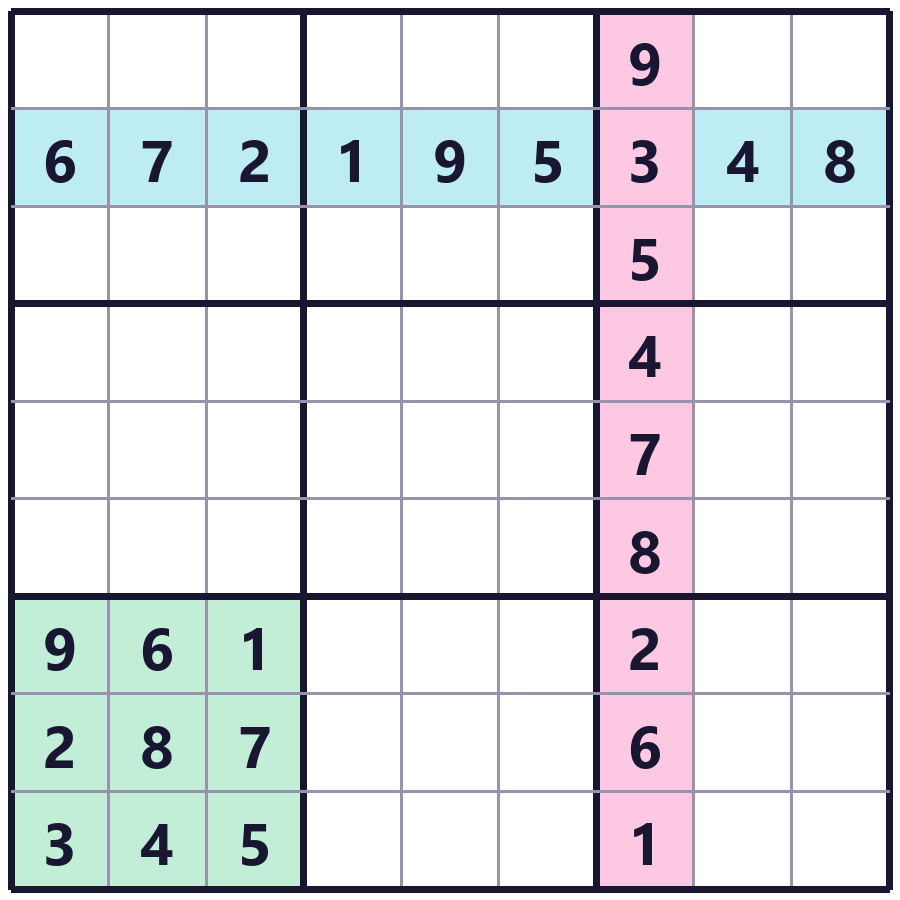
Every row, every column and every 3×3 box holds 1 to 9, once each. That is the whole game – the rest is how you work out where.
Fill the grid so that every row, every column and every 3×3 box holds the digits 1 to 9 exactly once. The digits printed at the start are fixed. Every puzzle in the books has exactly one way to finish, and it can be reached by reasoning from what is on the page.
Naked single
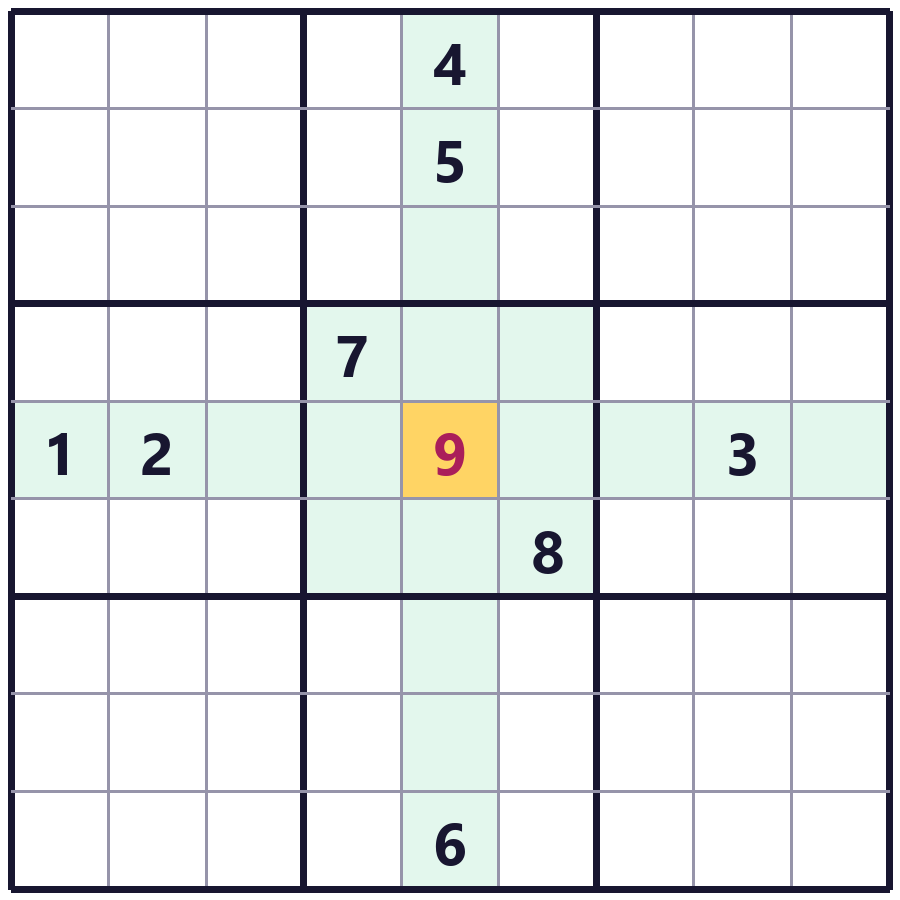
Look along the row, down the column and around the box of an empty square. Here 1 to 8 are all taken, so it can only be 9.
A cell with one candidate left: the other eight digits already appear in its row, its column or its box, so the survivor goes in. A full house is the same thing the other way round – a unit with one empty cell, where you count 1 to 9 and write in the one that is missing.
Pointing pair
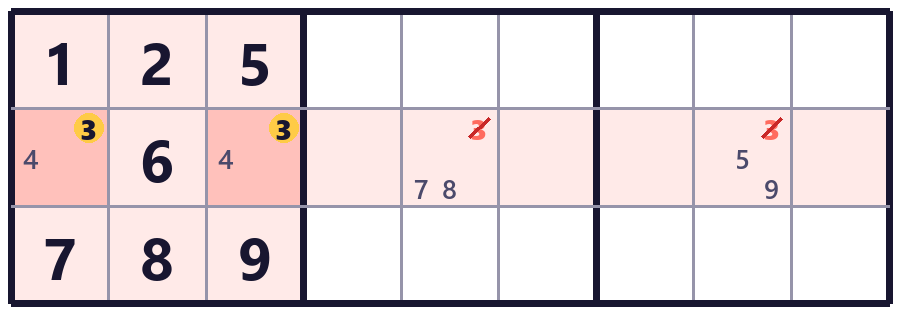
In this box, 3 fits only in the middle row. So whichever square takes it, no other square along that row can be 3.
Pointing: where a digit's only remaining places in a box all sit on one row or column, it must go somewhere along that line, so strike it from the rest of the line outside the box. Claiming is the reverse – where a digit's only places along a line all sit inside one box, strike it from the rest of that box.

Naked pair
Two squares in this row can only be 2 or 7, so between them they use both. Cross 2 and 7 off everywhere else in the row.
Two cells in the same unit holding the same two candidates and nothing else – say 2 and 7, twice over. Between them they will use both digits, in one order or the other, so neither can appear anywhere else in that unit.


Naked triple
Three squares in this row share just three candidates between them: 1, 4 and 9. Those digits are theirs, so strike them from the rest.
Three cells in a unit whose candidates, taken together, come to just three digits. No cell needs all three itself – two will do – but between them the three cells use all three digits, so no other cell in the unit can hold any of them.
X-Wing
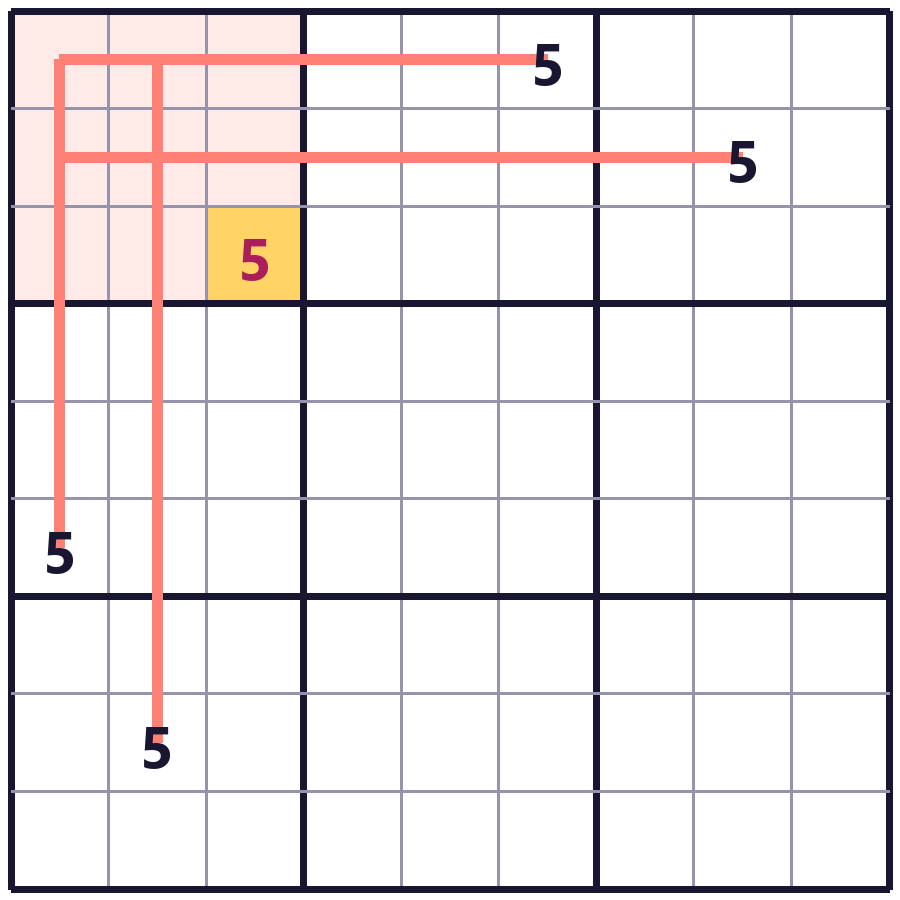
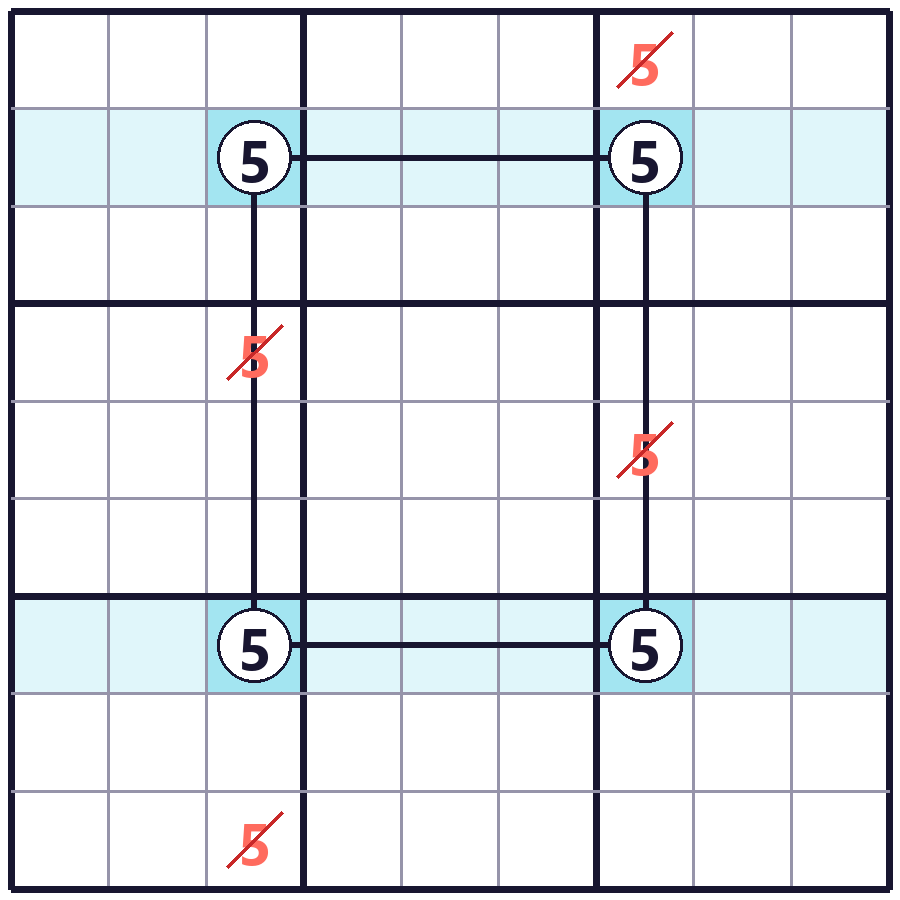
In two rows, 5 fits only in the same two columns – the corners of a rectangle. It takes two opposite corners, so strike 5 from the rest of both columns.
One digit, two rows, and in both rows its only places are the same two columns – the four corners of a rectangle. The digit takes opposite corners whichever way it falls, so both columns are spoken for and it can be struck from the rest of them. It works with rows and columns swapped as well.
Swordfish
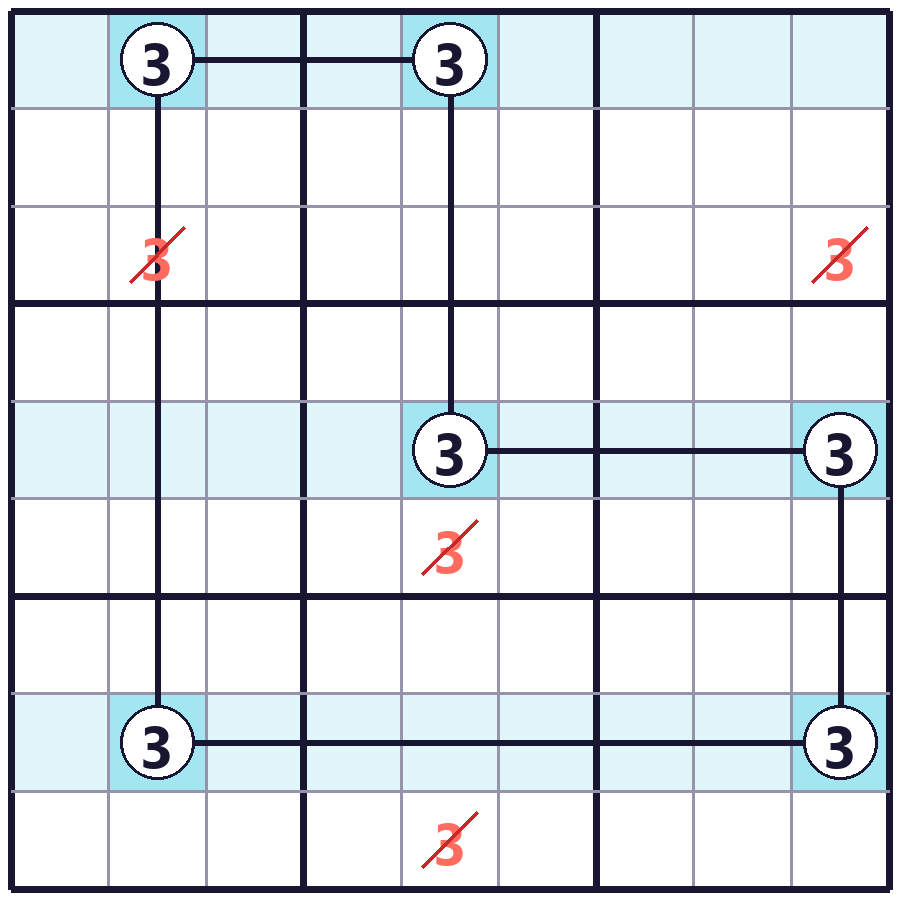
Across three rows, 3 is confined to the same three columns, so those rows use up every column's 3. Strike 3 from the rest of the columns.
An X-Wing stretched over three lines instead of two. A digit confined to the same three columns across three rows must use all three columns between them, so it can be struck from those columns everywhere else. Worth looking for once the pairs and triples have run out.
XY-Wing
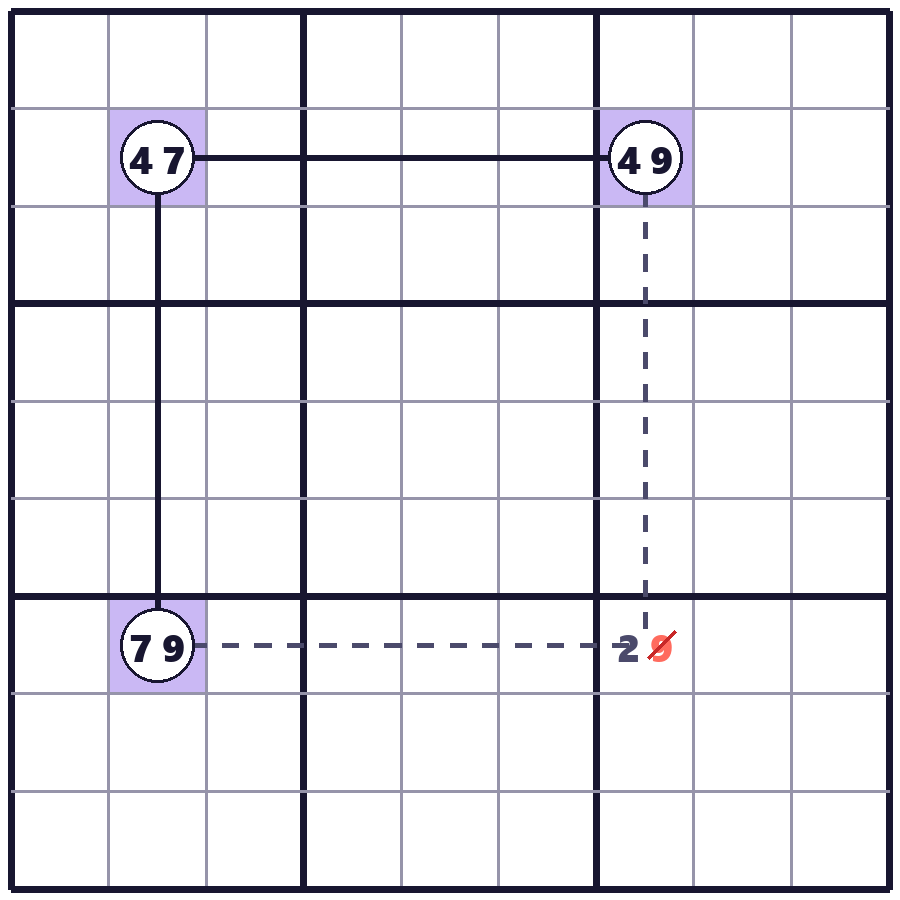
The pivot is 4 or 7. Either way one of its pincers becomes 9 – so the square both pincers can see cannot be 9.
Three cells of two candidates each: a pivot holding A and B, and two pincers that can both see the pivot, holding A and C, and B and C. Whichever the pivot turns out to be, one pincer is forced to C – so no cell that can see both pincers can be C.
Simple colouring
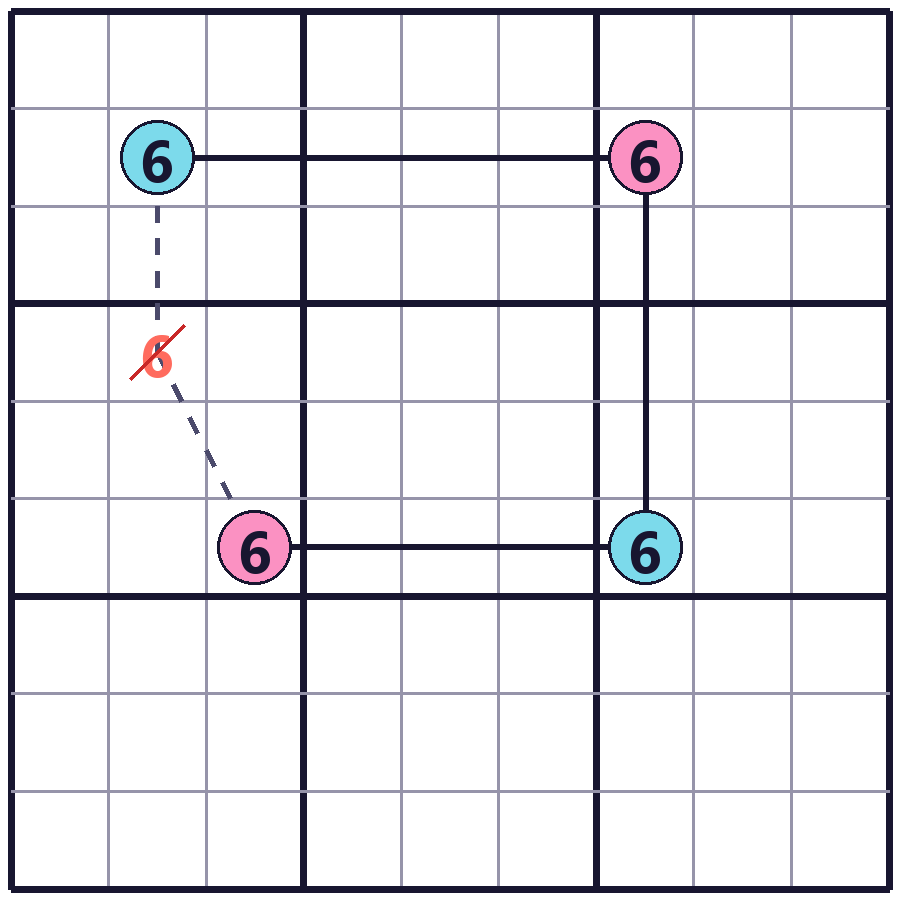
Colour the 6s that come in pairs, alternating along the links. One colour is right – and this square sees both, so it cannot be 6.
Take one digit. Wherever it has only two homes left in some unit, one of those two is true and the other is false – so mark them with opposite colours, and follow the links from cell to cell colouring as you go. Exactly one colour is the true one. Two things follow: if a colour turns up twice in the same unit it cannot be the true one, so every cell of that colour loses the digit; and any cell that can see both colours loses it too, because one of the two it sees will hold it. Nothing is assumed and nothing has to be unwound – it is bookkeeping over links already on the page.
Three hundred puzzles to practise on
Each of our large print books explains the steps its level needs, with the answers to every puzzle in the back.
Want the next pack?
We put out new printable packs — six fresh puzzles at a time, free to print. Leave an address and the next one comes to you.